Five candidates, two debates and one expensive question: Can students afford Colorado?
At DU, candidates for governor argued over Trump, Tina Peters, immigration, faith, taxes and each other. But for community college students, the real issue was simpler: after graduation, can they afford to stay?
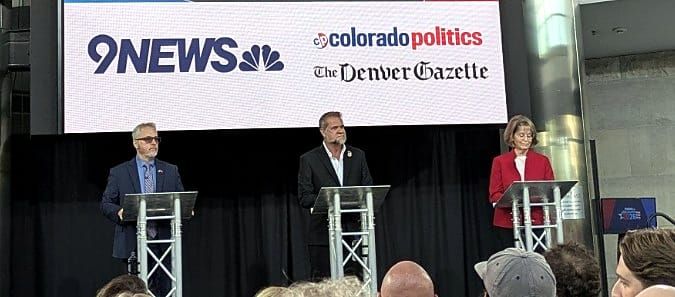
Colorado’s governor’s race got loud this week.
In the Republican debate at the University of Denver on June 2, candidates Barb Kirkmeyer, Scott Bottoms and Victor Marx fought over credibility, immigration, faith, party loyalty and whether Republicans can win statewide after years out of power. Two days later, Democratic candidates Michael Bennet and Phil Weiser used their own DU debate to clash over Donald Trump, ICE, campaign money, Gov. Jared Polis and who should lead Colorado after the Polis era.
But underneath the attacks, one issue kept coming back: Colorado is too expensive for the people who are supposed to build their lives here.
For community college students trying to build a future in Colorado, the governor’s race is not just about party labels. It is about rent, gas, groceries, child care, jobs and whether a first real paycheck will be enough to stay.
Bennet made affordability the center of his argument in the Democratic debate.
“When I followed Susan to Colorado, that’s how I got here,” Bennet said. “We were able to buy a starter home in this community. I’m not going to tell you what it cost because people that are younger than we are start to cry when I tell them how affordable it was.” He said that dream is no longer possible for too many Coloradans.
Weiser gave a more policy-heavy answer. He said teachers, firefighters, police officers and nurses should be able to afford homes in the communities where they work. His plan included more townhomes, more density, condominiums and down payment assistance.
On the Republican side, Kirkmeyer was the only candidate who directly named college students in an affordability answer. She said her work on property taxes was meant to help “those college students who are graduating” have “an opportunity to afford a home at some point” in Colorado.
Marx also framed housing as a youth issue.
“More teenagers graduate from high school, when they leave, they can’t come back because of the cost of living,” Marx said.
That was one of the clearest student-relevant lines of either debate. It cut through the normal campaign talk. The question is not only whether Colorado can educate young people. It is whether Colorado can keep them.
The candidates split sharply on what to do about it.
Kirkmeyer pointed to state boards, commissions and regulations. She said the governor appoints people to more than 300 boards and commissions that shape rules for industries across Colorado, and she said she would use those appointments to pull back regulations that she argued increase costs. She also pointed to delays in water and wastewater permits as a barrier to housing.
Bottoms said the answer was deregulation and property taxes.
“The number one thing is to deregulate, and then we have to attack property taxes,” Bottoms said. He suggested bringing back Gallagher or “a form of Gallagher,” referring to Colorado’s former property tax system.
Marx described the pain more clearly than the fix. He said the cost of living is “probably the biggest thing on people’s hearts and minds right now” and blamed taxes, fees, permitting delays and state spending. When pressed for a specific executive action or legislation he could get done with Democrats, Marx said he would “negotiate with people to accomplish a greater good.” Moderator Kyle Clark told him, “I didn’t hear any specific answer.”
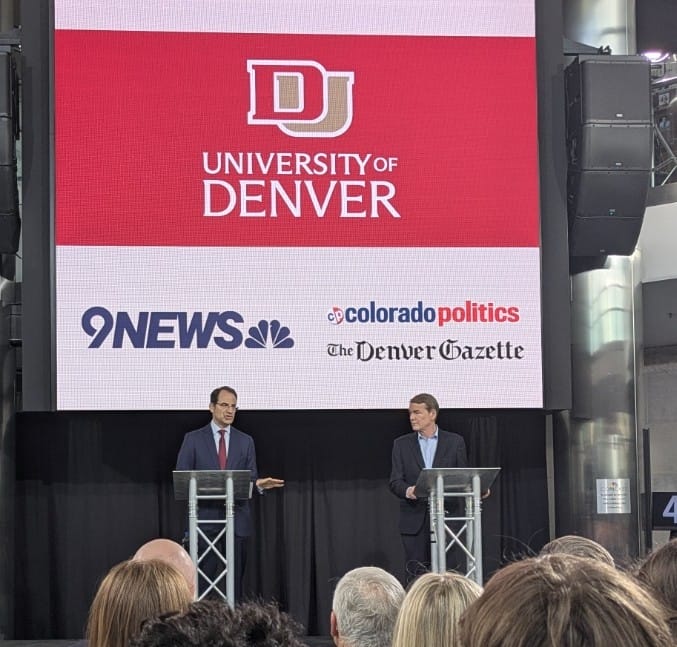
The Democratic debate spent more time on renter protections and working-class affordability. Both Bennet and Weiser said they would sign a bill banning algorithmic software used to set rent prices, a policy aimed at landlords accused by consumer advocates of using software to drive up rent. Weiser said he “absolutely” would sign it and pointed to a lawsuit on the same issue. Bennet said he would sign it too.
Immigration was another clear dividing line, especially for students from immigrant or mixed-status families.
Bennet said he has fought for immigrant communities since he was superintendent of Denver Public Schools and worked to make sure students had access to in-state tuition.
Weiser said immigrant communities should know that “when you call 911, you’re not jeopardizing your family’s potential safety.” He said Colorado law enforcement should do law enforcement, not federal immigration enforcement.
Republican candidates took the opposite direction. Kirkmeyer said she would seek to roll back Colorado limits on cooperation with federal immigration enforcement. Bottoms said he would “definitely withhold funds” from sanctuary cities and said “we might need to put some mayors in jail.” Kirkmeyer pushed back on the funding question, saying residents should not lose services because of local leadership decisions.
Education came up, but not always in the same way.
Kirkmeyer accused Democrats of balancing the budget “on the backs of students” by cutting school funding, calling it a constitutional issue. Later, she said Colorado has a spending problem and must prioritize education because it is required by the state constitution.
Bennet tied education to the economy, saying Colorado has to make sure its education system is preparing students for the jobs they will inherit. Weiser focused more on youth safety, tying fentanyl, gun violence, social media and mentoring to his broader pitch for protecting young Coloradans.
For community college students, that is where the debates became more useful. The best answers connected school to work, rent to wages, and public policy to the actual cost of becoming an adult in Colorado.
There was still plenty of noise.
After moderating both debates, 9NEWS anchor Kyle Clark gave FoxTalk a simple test for students watching candidates.
Asked what students should listen for to tell the difference between campaign spin and a governing plan, Clark said voters can usually hear when a candidate understands what they are talking about.
“I think folks instinctively know when they hear somebody talk, whether they have any idea what they’re talking about, whether they’re talking out of their mouth or somewhere else,” Clark said.
But Clark said competence is not the only test.
“Somebody who has a functional understanding of how government works and would do things that you don’t want to accomplish is not particularly useful to you,” Clark said. “So, yes, it’s important to determine which end they’re speaking out of, but then also to determine how it lines up with your views and values.”
The Republican debate included accusations that Marx was a “con man,” disputes over his claimed overseas rescue work and a tense exchange about Bottoms’ unsupported claims involving Venezuelan gang members. The Democratic debate included repeated attacks over Trump, lawsuits, campaign money and whether Bennet should leave the U.S. Senate to run for governor.
But for students, the sharper test is practical: Which candidate can explain how a student gets from a classroom to a stable life?
A student finishing at CCA does not need a slogan about affordability. They need to know whether Colorado will still offer affordable rent, stable jobs, safe communities and a real future after graduation.
Primary ballots begin mailing June 8 and must be returned by 7 p.m. June 30, according to Colorado Politics.
Comments ()