ChatGPT can write the essay. So what is English class for?
Arlinne Rico and other students are drawing the line between using AI as a shortcut and losing the voice, thought and struggle that make writing their own.
“You don’t really think about it. You just type in the little chat box, and that’s it.”
That is how CCA student Arlinne Rico described what happens when students lean too hard on AI for English work. It is also the question hanging over college writing classes right now. If ChatGPT can produce a decent essay in seconds, what exactly is English class supposed to teach?
At CCA, faculty say the answer is not just writing a paper.
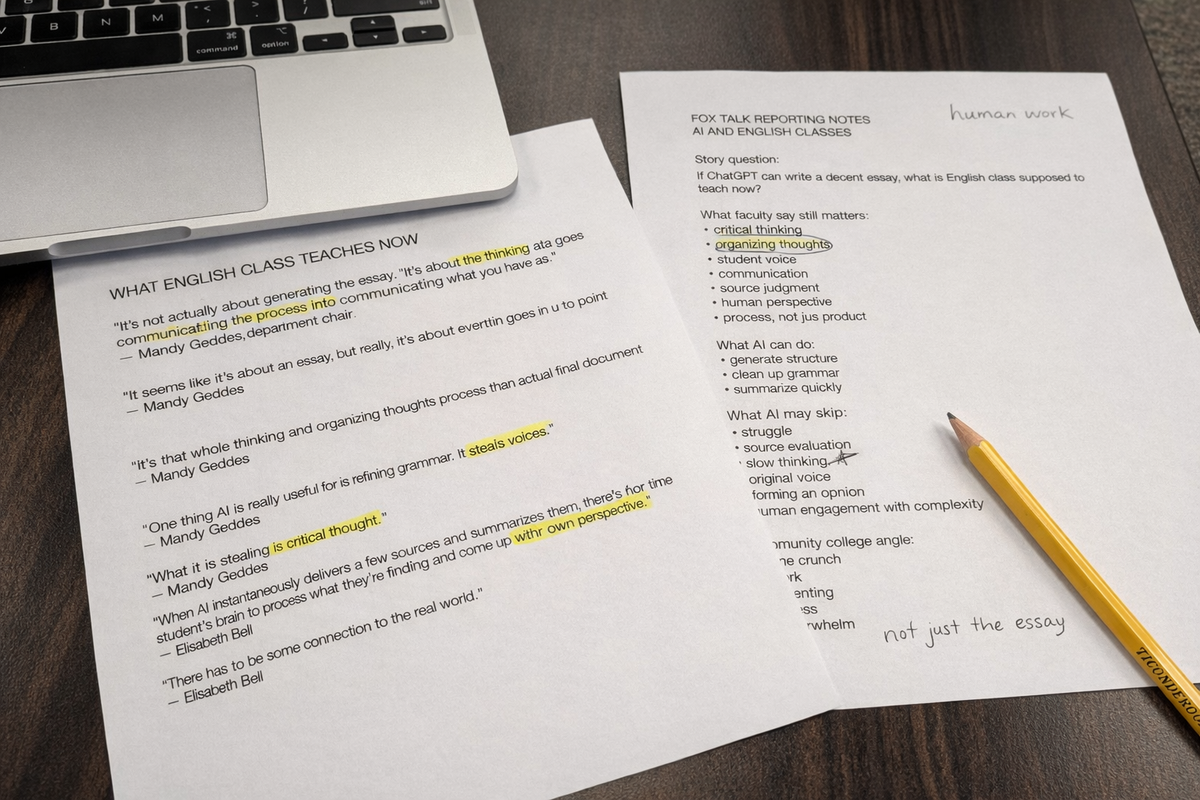
“It’s not actually about generating the essay,” said Mandy Geddes, chair of CCA’s English department. “It’s about the thinking and the process.” In her view, students often mistake English classes for places where they learn how to produce a finished assignment, when the real point is learning how to organize ideas, communicate clearly and think critically before the final draft even exists.
When AI starts thinking for students
That concern came up again and again in interviews with English faculty.
Mary Sellers, an English instructor, said the line gets crossed when AI stops helping students think and starts thinking for them. She said student writing should sound like a real person, with all the quirks and texture that come with it, not a polished block of generic language. Describing what overused AI can do to a student’s writing, Sellers used an image that is hard to forget: “The beautiful voice of a student is like the Rocky Mountains,” she said, but when AI comes in and over-polishes it, “it chops it off and makes it all flat.”
For Sellers, writing still matters because it is more than a school task. “If you view writing as a process of discovery, AI can’t do that for you,” she said. Later, she put it even more bluntly: “AI is not a creator. AI is a compiler.”
The slow work still matters
Elisabeth “Elsie” Bell, another English instructor, made a similar argument from the research side of writing. She said students lose something important when AI instantly finds sources and spits out summaries. “The slow process gives room for thought,” Bell said. In her view, the time spent searching, reading, comparing and processing sources is not wasted time. It is the learning. Without that process, students may get a cleaner product but miss the mental work that gives writing depth in the first place.
Bell said that concern has already changed the way she teaches. Rather than relying on assignments AI can easily mimic, she has shifted toward projects grounded in real-world experience, including off-screen, material work that asks students to observe, practice and reflect before they write.
Why students use it anyway
Students, though, described a more complicated reality than a simple yes-or-no debate over AI.
Rico said students often turn to AI because they are stuck, procrastinating or trying to finish work quickly under pressure. At a community college, that pressure can be constant. Geddes said many CCA students are working, parenting, managing family responsibilities or trying to keep up with several demands at once. In that environment, AI can look less like a philosophical problem and more like a shortcut that feels hard to resist.
Where students draw the line
But even students who saw some value in AI drew limits.
Ilahny Miranda said AI can sometimes help her get started by giving her a direction or a topic to build from. But she said it falls apart when the writing becomes personal. “Personal stories, it’s something for you to express, and I don’t think a computer can really do that,” she said. Later, she put the bigger issue in simple terms: “You’re not really learning if it’s doing all the thinking.”
Amira Ouazrane described AI more as a support tool than a substitute writer. She said she uses it to help find information that supports ideas she already has, not to generate the ideas themselves. Writing on her own, she said, still teaches things AI cannot replace, including grammar, vocabulary and how to phrase something clearly. “That’s how you learn,” Ouazrane said. “That’s how you retain information, and become a better learner and a better student.”
Rico, who said English is not her first language, said doing the writing herself still matters even when it is difficult because feedback helps her improve over time. That tension ran through the student interviews. AI may help students move faster, but several students also recognized that speed is not the same as learning.
Polished does not mean learned
That may be the real pressure point now for English classes.
AI has made it easier than ever to turn in something polished. What CCA faculty keep challenging is the idea that polished means learned. Geddes said English classes still have to teach students how to think, organize, communicate and develop a point of view. Bell said students need time to work through ideas long enough to make them their own. Sellers said writing should still carry a real person’s voice.
So if ChatGPT can write the essay, what is English class for now?
At CCA, the answer was not grammar for grammar’s sake or one more finished paper. It was learning how to think your way into your own words. That is why several students who use AI in limited ways still drew a line at letting it do the work for them. Or, as Sellers put it, “AI is not a creator. AI is a compiler.”



Comments ()