Before the pushback: Three student journalists on protecting their independence
At Young Invincibles’ 2026 National Summit, student journalists from North Carolina A&T, Cornell and Northeastern Illinois described different ways they would respond if someone tried to stop a story from being published.
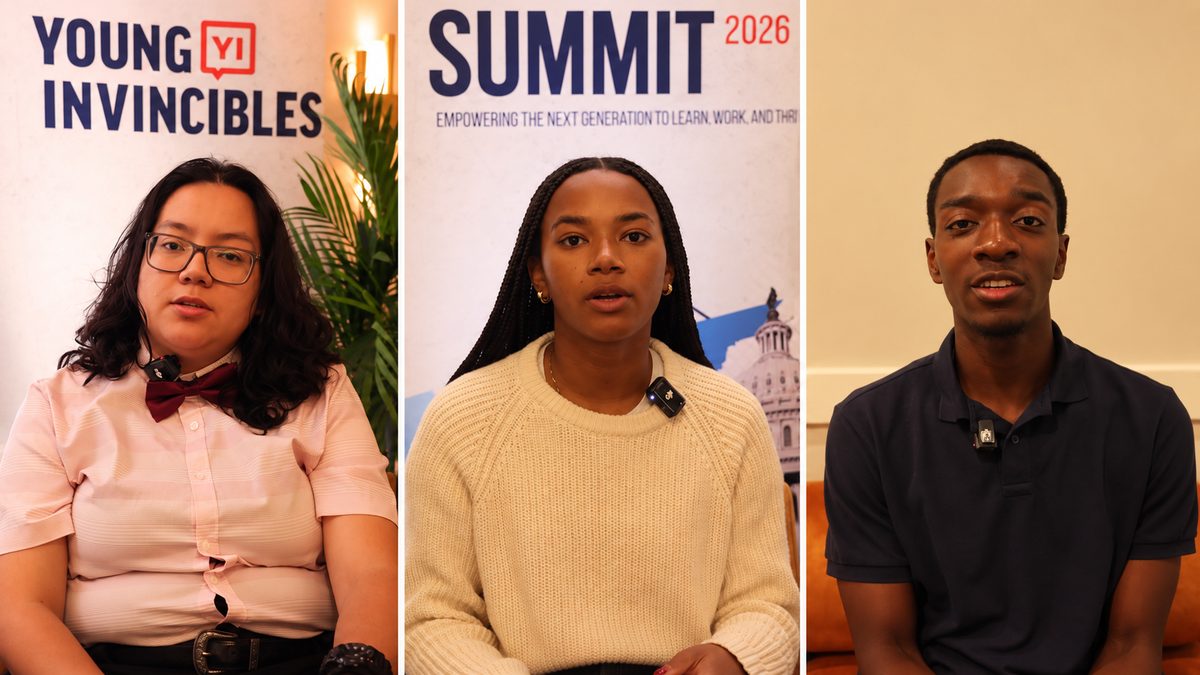
At Young Invincibles’ National Summit in Washington, D.C., I asked three student journalists a question that can become urgent very quickly in a newsroom: If someone at your school tried to stop a story before publication, would you know what to do next or where to go for help?
Their answers were different.
Cameron Smith, a senior journalism student at North Carolina A&T State University and editor-in-chief of the A&T Register, had a general plan. He said he would start by defending the publication’s right to report verified facts, then look to a higher administrative level if necessary. He would also turn to the Register’s adviser and, if the problem went further, seek help from an outside organization.
“I would definitely try to contact an organization that could kind of stand on our behalf,” Smith said.
Isabella Hanson, a Cornell University senior studying English and American Studies, was less certain about where she would turn outside her newsroom. Hanson is a senior writer for The Cornell Daily Sun and previously served as a news editor on its administration beat. The Sun operates independently from Cornell, with its office off campus in downtown Ithaca.
“I would definitely have to look for resources online,” Hanson said.
She said the paper sometimes receives pushback from university administrators. In those situations, she described the response as a process of negotiating while trying to preserve the paper’s independence and making sure the reporting is thoroughly fact-checked.
Jasmine Rodriguez, a graduate student studying English literature at Northeastern Illinois University in Chicago, had a more specific answer. Rodriguez has held several positions in student media, including chief copy editor and managing editor, and is serving as a copy editor this semester.
Rodriguez said her newsroom had previously turned to an outside student press freedom initiative for guidance during a conflict connected to its reporting. Unlike Smith and Hanson, she could point to a resource her newsroom had already used when questions about press freedom arose.
For Rodriguez, knowing where to seek help was only part of being prepared. She also emphasized the value of student journalists supporting one another. Her university has several student media organizations, she said, and those groups can function as a network when one of them faces pressure.
“We very much support each other,” Rodriguez said. “We’re a coalition of student media.”
These three conversations are not a survey of student journalists, and they do not show how common censorship or administrative pressure is on college campuses. But they do show how differently student journalists can approach the same hypothetical problem.
Smith learned the importance of preparation earlier in his reporting career. As a sophomore, he reported on a campus DJ who said she had been robbed after performing in another city. Because the underlying case was still developing, Smith said his editors were cautious about publishing the story.
“The things I could confirm, I did,” Smith said. The story was ultimately published, he said, because the newsroom was confident in the facts it had established.
Hanson described another kind of pressure: reporting on people and institutions that are part of your own daily life. While covering Cornell’s student assembly, she reported on a dispute over funding for student organizations representing different cultures and racial groups. She recalled sitting in the room as students she identified with protested while she remained in her role as the reporter.
Student journalism, she said, gives students an unusual opportunity to cover a community while they are still living inside it.
“It’s important to kind of take charge of what you’re saying and stand by it,” Hanson said.
Smith put the obligation simply: “We have a duty to report the truth.”
This article was reported as part of the Young Invincibles Student Media Fellowship.
Comments ()