Kirkmeyer gives community college students a test for her first year: tuition, aid and state funding
The Republican candidate said she would protect colleges’ base funding, consider a transfer grant and seek student input on changes to Colorado’s community college system.
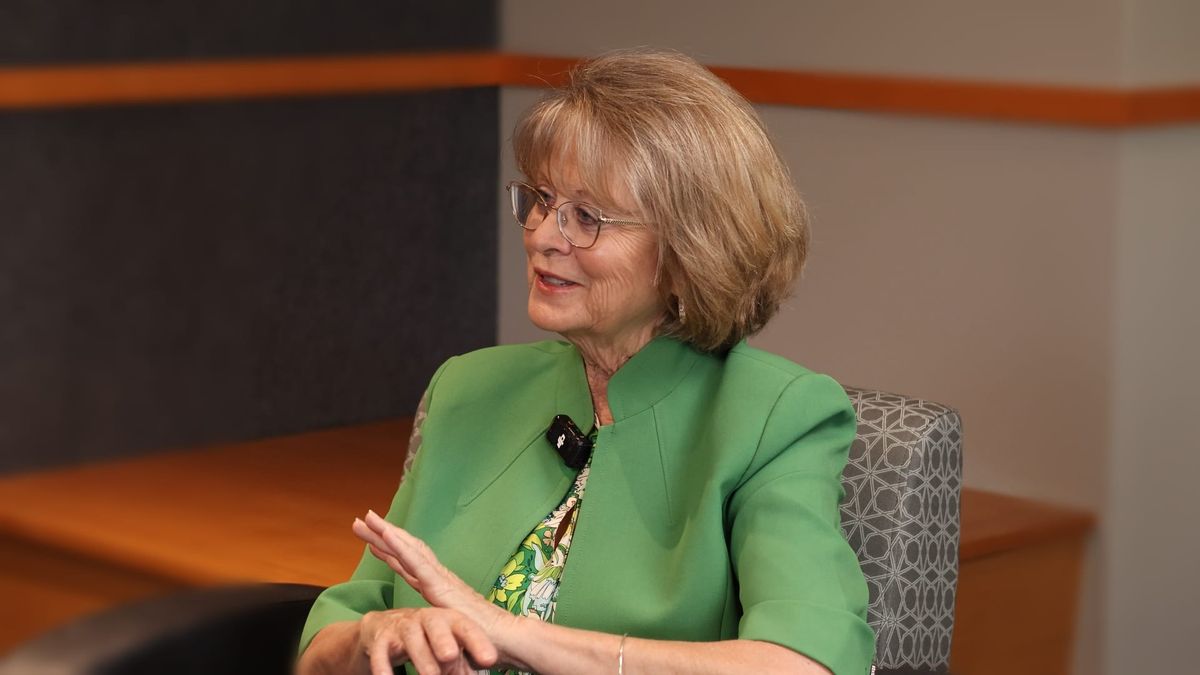
Barb Kirkmeyer gave community college students three numbers to examine if she becomes governor: tuition increases, financial aid and state support for higher education.
The Republican candidate said students should compare whether tuition rose by 5% or 6% during her first year, or whether her administration held the increase closer to 2% or 3%.
They should also examine whether financial aid remained available and how much money her budget sent to Colorado’s public colleges, she said.
“That’s the goal, is how do we keep tuition low,” Kirkmeyer said during a sit-down interview with FoxTalk.
Kirkmeyer leaned on her experience with the Legislature’s Joint Budget Committee as she described her approach to colleges. She said her first budget request would protect the core state funding used by community colleges and four-year institutions.
She accused Gov. Jared Polis’ administration of underfunding an agreed-upon base amount in recent budgets and said she had worked to preserve it.
Those dollars, Kirkmeyer said, help colleges “keep their doors open and hopefully keep tuition low.”
A cut to the department, not campuses
Kirkmeyer’s broader affordability plan calls for reducing personnel costs across state agencies. When I asked whether that would include higher education, she drew a distinction between the state department and individual colleges.
“It would apply more to the actual department itself,” she said.
Kirkmeyer said she would seek a 5% to 10% reduction across the Colorado Department of Higher Education’s personnel and operating lines.
She said the reduction would not apply directly to community colleges or institutions such as the University of Northern Colorado.
“It would apply to the department, the administrative part of the higher education department,” she said.
Kirkmeyer did not identify which jobs, programs or services would be reduced. The department coordinates financial-aid policy, transfer programs, statewide data and other work connecting the state’s colleges.
Her answer leaves students with two measures to watch at the same time: whether campus funding is protected and whether department reductions affect services students use.
Open to transfer assistance
Kirkmeyer said she would consider a state grant for students who finish an associate degree and transfer to a Colorado public university.
She stopped short of committing to one.
“I’m open to looking at that, and it has to also be something that we can afford within our budget,” she said.
Colorado already has transfer agreements that allow qualifying community-college courses and associate degrees to count toward participating four-year programs. A new grant would add financial support to that academic pathway.
Kirkmeyer pointed to the College Opportunity Fund, which provides a state tuition stipend for eligible undergraduate students, as an example of legislation she has supported.
Bright Futures as a model
Kirkmeyer also cited Weld County’s Bright Futures grant program as an example of local government helping residents continue their education.
Weld County launched Bright Futures in 2015 as a workforce-development program that provided grants for college and vocational training. Kirkmeyer later served on its board while she was a county commissioner.
In 2019, when Kirkmeyer chaired the Weld County Board of Commissioners, the county announced a hospital-property agreement that placed an estimated $59.4 million into an endowment. Commissioners initially directed the endowment’s earnings, estimated at $2.5 million per year, to Bright Futures.
The sale did not create Bright Futures, which had existed for about four years. It gave the program a major source of continuing financial support.
Kirkmeyer said she would look for similar approaches as governor.
“I would continue to look for things like that to assist with students and individuals being able to continue with their postsecondary education,” she said.
Students at the table
Asked what she could change without waiting for the Legislature, Kirkmeyer first pointed to the governor’s authority over higher-education leadership.
“The first change would be who the executive director is and who’s the commissioner of higher education,” she said.
She did not say whether she intended to replace a particular official. She said the governor could use that appointment and direct work with students to identify changes within the community college system.
“The people who have to live with what’s being put forward and what they’re working their way through, we could work with them,” Kirkmeyer said.
She said students likely had ideas about how to improve the system and that she was open to hearing them.
On employment, Kirkmeyer declined to limit college partnerships to a short list of industries. She named health care, aerospace, engineering, oil and gas and artificial intelligence, then said the state should hear from any industry willing to help expand educational opportunities.
“If somebody’s got some great ideas, man, I’m all on board,” she said.
Where direct benefits remain uncertain
Some of Kirkmeyer’s answers relied on indirect effects rather than a benefit guaranteed to reach students.
Asked how lowering property taxes would help a student renting an apartment, Kirkmeyer said apartment owners would pay less and “hopefully” would not need to raise rents as quickly.
She did not propose a requirement that landlords pass the savings to tenants.
Asked about students who cannot afford cars, Kirkmeyer said safer, better-maintained roads would also benefit buses and bicycles. She did not identify a student transit subsidy or reduced-fare program.
Her most direct commitment to community college students was to protect institutional funding and judge the result through tuition, aid and the state budget.
One year into a Kirkmeyer administration, she said students should look at “whether or not the increase for tuition was kept down,” whether financial aid was maintained and how much state funding went to higher education.
The interview was produced by FoxTalk as part of a question-sharing and distribution partnership with The Metropolitan, MSU Denver’s student newspaper.
Comments ()