He Traded Graduation for a Day’s Pay. Then He Made It to CU Anschutz Nursing.
Parker Rand chose community college because it cost less and offered the same value for his prerequisites. Now the Colorado native is studying in the state’s top-ranked BSN program.
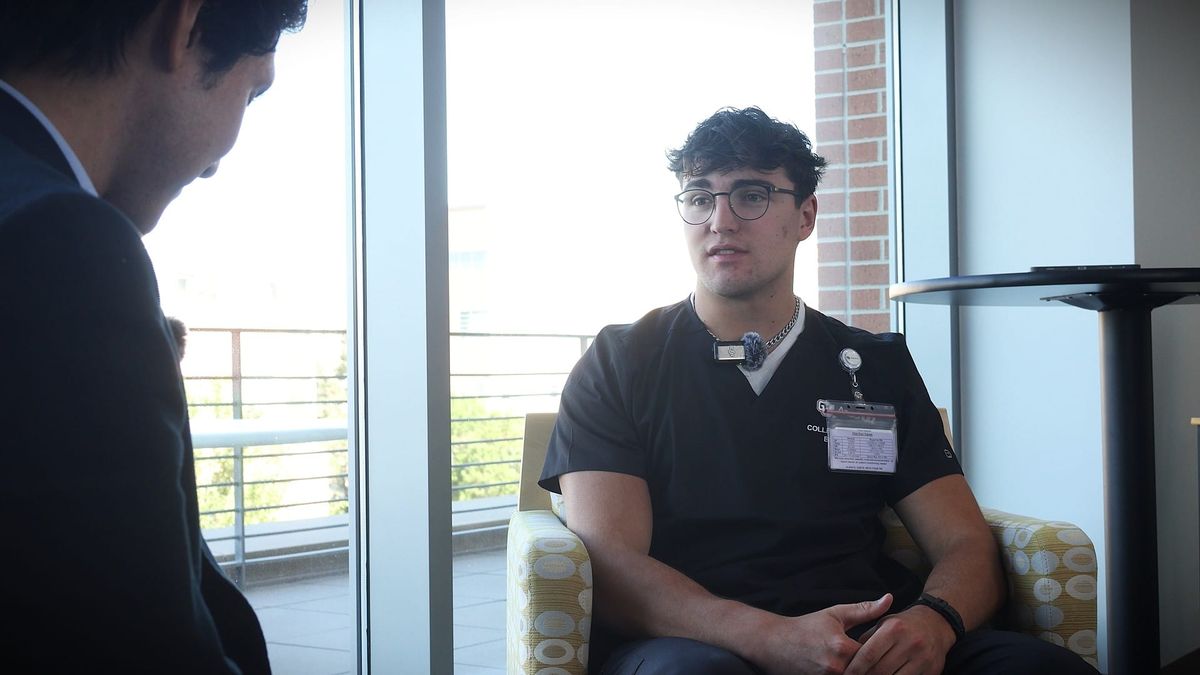
Parker Rand did not walk across the stage at the Community College of Aurora’s graduation ceremony. He went to work.
Rand said he would have liked the chance to celebrate completing the first stage of his nursing education and “pat myself on the back.” Then he considered what missing a shift would cost.
“Could I use a day’s work of pay in turn for missing one graduation?” Rand said. “Probably.”
The same practical calculation shaped his decision to begin at community college.
“The big reason I chose community college was, A, it’s cheaper, and B, for me, after looking at the value that other schools, or specifically four-year schools, could provide for those prerequisites versus the value community college could provide, to me, I saw them as the same,” Rand said.
That choice eventually carried him into CU Anschutz Nursing through the Integrated Nursing Pathway, a four-year route that begins with prerequisite classes at one of three Denver-area community colleges. Students then complete two years of nursing courses at CU Anschutz. CCA says students in the program earn an associate degree from CCA and are selected through an application process.
Rand said his mother discovered the pathway online while they were comparing nursing programs. They considered the Denver College of Nursing, Metropolitan State University of Denver and other options before settling on the CCA and CU Anschutz route.
“There was just something about the integrated pathway through CCA that was very, very appealing to me,” he said.
When he learned that he had been accepted, the practical college decision suddenly felt real.
“My heart definitely skipped a beat,” Rand said. “It was like, ‘Oh my God, this is really happening.’”
He is now taking classes at CU Anschutz Nursing, whose bachelor’s program ranked No. 19 nationally among more than 650 programs in the 2025 U.S. News & World Report rankings. CU identifies it as Colorado’s highest-ranked BSN program. The college also reported that 96.02% of its first-time bachelor’s graduates passed the national nursing licensing examination in 2025, compared with 87.6% nationally.
Rand described entering that environment as both exciting and intimidating.
“It’s definitely wild, definitely indescribable,” he said. “It’s a little intimidating, but it’s definitely worth it.”
Nursing was a ‘hidden path’
Rand did not grow up planning to become a nurse.
He called nursing a “hidden path” that he began considering only about a year and a half ago. Growing up in Colorado, much of his identity centered on staying active and competing in sports.
“I wouldn’t have grown up anywhere else,” Rand said. “A lot of great memories” came from playing soccer, football and hockey.
His interest eventually shifted from how his own body performed to how human bodies function, fail and recover.
“We’re almost like machines, and we can break down and figure out what’s wrong with us and basically fix us to some degree,” Rand said. “It’s crazy to me how many things can go wrong and how many things can kill us, yet we still function and survive.”
One of the features that attracted him to CU Anschutz was its simulation laboratory.
CU describes its simulation facilities as the largest nursing simulation operation in the Rocky Mountain region, with 20,000 square feet across three locations. The equipment includes manikins that breathe and speak, professional actors who simulate mental-health encounters and virtual-reality emergency scenarios.
Rand had a simpler way to communicate the stakes.
“There’s definitely a level of pressure that’s there,” he said. “It’s partially because the mannequins sometimes cost as much as the house does.”
The equipment is designed to make students feel as though they are treating a real patient, he said.
“They really, really want to simulate what it’s like working with a patient,” Rand said.
Rand called himself a perfectionist when it comes to school. His method for handling pressure is brief: breathe, stay calm and find a mental space where he can feel comfortable.
His study habits are more visual. During the interview, Rand opened a notebook and walked through a drawing of the kidney’s filtration system. He pointed to the difference between a healthy kidney and one affected by disease, explaining how damaged structures can allow blood cells and proteins to enter urine.
“Drawing things out, or seeing things and how they would affect it, is really what helps me,” he said.
The diagram reduced a complicated biological process to something Rand could see clearly. It also showed what now holds his attention: how much can go wrong inside the human body, and how much work goes into learning how to respond.



Comments ()